For the past two years, most of the AI conversation in IT has revolved around assistance. AI helps technicians summarize tickets, suggest knowledge base articles, flag anomalies, or speed up documentation. Don’t misunderstand – those gains are real, but they do not fundamentally change how the work gets done. Human teams still own the queue, the triage, and the follow-through.
ManageEngine clearly sees things – and the next phase of AI in IT – differently. The enterprise IT management division of Zoho Corporation has introduced Zia Agents into its digital enterprise management portfolio. In doing so, the company is effectively positioning autonomous AI agents not just as tools that support work, but as systems designed to execute it across service management, observability, endpoint management, and security operations. That’s a significant shift from the AI-assisted work that was the first generation of AI in IT.
That is an enterprise IT story, for sure, but it also has clear implications for MSPs. Their technicians face many of the same pressures as internal IT teams, only multiplied across entire customer bases. That means more repetitive ticket handling, more endpoint administration, more security triage, more compliance overhead, and a constant need to scale services without scaling headcount at the same rate. From their perspective, the real promise of autonomous agents is not a novelty, but a real operational advantage.
ManageEngine already offers MSP-focused platforms such as ServiceDesk Plus MSP and Endpoint Central MSP, and it has existing Zia functionality for the MSP service desk environment, including virtual assistant capabilities and workflow support. While the latest Zia Agents messaging leads with the enterprise IT story, it stands to reason there will be an MSP story here, too.
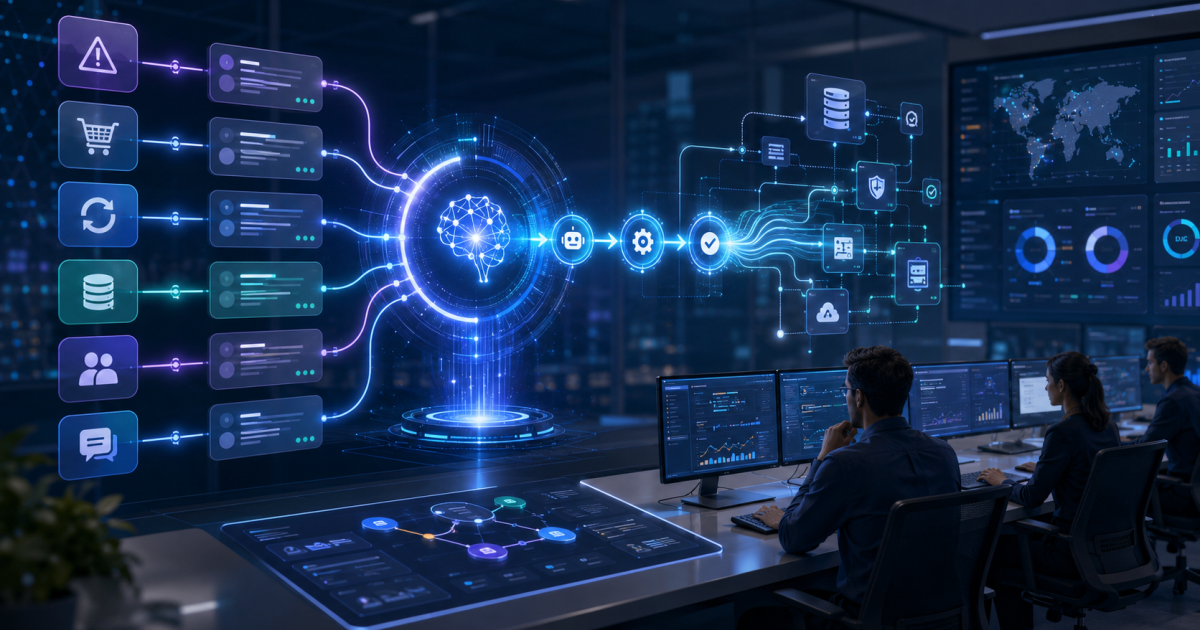
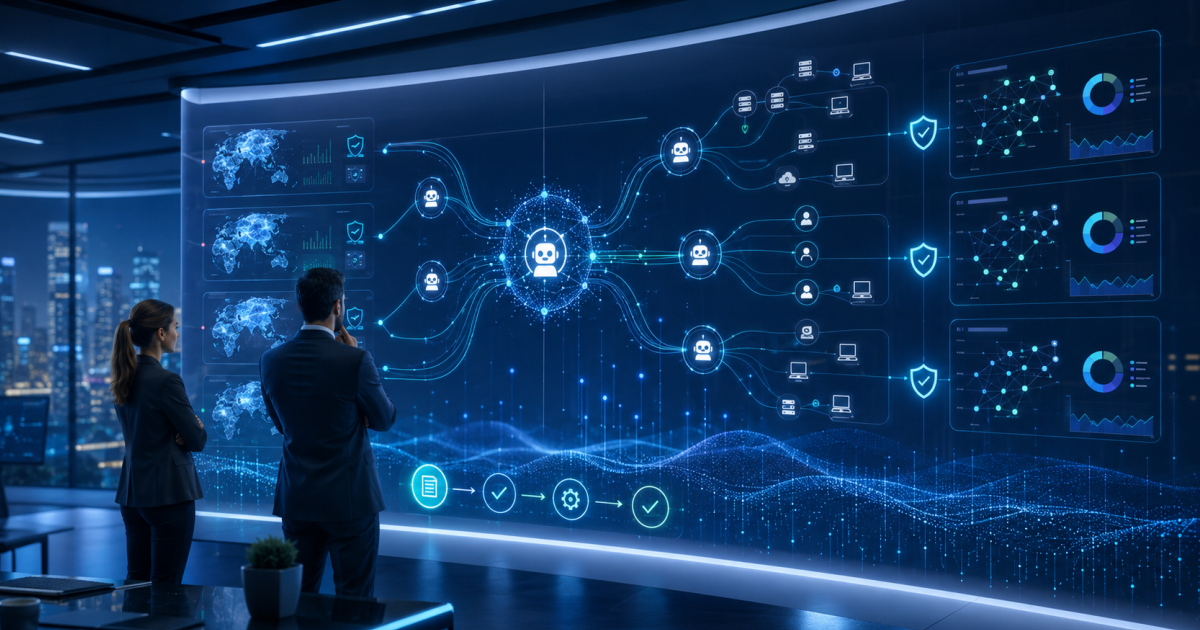
Zia Agents are being deployed across ITSM, full-stack observability, endpoint management, and security operations, all built on a shared agentic platform intended to support cross-product intelligence without extensive custom integration work. For more complex workflows, ManageEngine is also introducing multi-agent orchestration, allowing a master agent to coordinate specialized subagents and route tasks automatically.
“The frontier models are great for all-purpose use but are not often efficient for specific areas like enterprise IT,” said Rajesh Ganesan, ManageEngine CEO. “We take great care in building AI technology that is not only purpose-built, but also provides value in terms of cost and long-term use. We are excited to bring autonomous AI capabilities to our offerings and provide a reliable platform for our customers to achieve efficient outcomes.”
The individual use cases span a wide range of IT work. In service management, ManageEngine is touting prebuilt agents for first-line service desk activity, post-incident review generation, and knowledge base creation. In IT operations, its agents are positioned to move beyond traditional observability by identifying likely root causes, triggering recovery actions, and investigating cloud cost anomalies. For security operations, there’s a similar message around operational efficiency through fewer manual steps, faster correlation, and more autonomous investigation support. ManageEngine is also tying agentic automation to practical tasks in endpoint management, such as patching, device queries, software deployment, and broader endpoint operations.
For MSPs, that translates into a straightforward question: Can agents meaningfully reduce repetitive work and help technicians scale workloads? If AI can handle more of the routine service desk burden, accelerate endpoint tasks, and standardize actions across environments, it stands to reason the answer is yes. That makes AI feel less like a feature and more like an operating model, which is where the MSP impact really lies.
Service providers are not looking for AI as a demo. They are looking for AI that lowers technician load, shortens response times, and makes service delivery more consistent across customers. They want – and need – AI to have a positive impact on their IT service delivery.
But, back to Zia Agents and the customization story. Through Zia Agent Studio, customers can configure agents using natural language, use prebuilt agents, or build agents from scratch while controlling the tools, knowledge sources, and behavioral guardrails available to each one. ManageEngine says administrators will have visibility into agent actions through built-in audit trails – an important control for enterprise IT teams, but arguably even more important for MSPs, where automation has to operate inside stricter boundaries across multiple clients and regulatory environments.
That speaks to one of the biggest challenges to broader AI adoption in IT operations – governance. ManageEngine emphasizes that customer data is not used to train its AI models and that its privacy and sovereignty principles carry forward into the agentic layer. Those assurances are important in building trust with any IT team or organization, but will likely be even more relevant as the company wants it autonomous AI strategy to truly resonate with MSPs, where trust, customer separation, and auditability are critical.
“The privacy principles adopted by ManageEngine for the last two decades in building our stack now stands vindicated even more in the age of AI agents,” said Umasankar Narayanasamy, ManageEngine Vice President. “Our commitment to upholding the principles of data privacy and sovereignty gives assurance to our customers to adopt AI agents with confidence.”
It’s also worth noting that ManageEngine also supports Model Context Protocol, giving customers a way to connect ManageEngine tools with third-party LLMs and agentic platforms. That may be more important than it appears on the surface because few enterprise environments – and few MSP stacks – are not built around a single vendor’s IT stack, but are heterogeneous environments. As a result, interoperability matters as much as raw AI capability.
Autonomous AI agents are no longer a future concept inside IT management. They are becoming part of product strategy. ManageEngine, specifically, is betting that customers are ready to move beyond AI assistance and toward real AI execution. For enterprise IT, that’s a big step forward and, for MSPs, it’s worth watching closely. Even if the current Zia Agents launch is designed for enterprise IT, the direction is obvious for MSPs: AI agents will mean fewer repetitive tasks landing on technicians, more standardized execution, and easier operational scalability.
Edited by
Erik Linask