The traditional MSP operated on a simple theory that more tools equals more capability. You have a PSA for ticketing, an RMM for endpoint management, an MDM for mobile devices, a separate security stack layered on top, and then a growing list of add-ons to fill the gaps between them. Over time, that produced an industry that became very good at managing complexity, but much less efficient than it should have been — and has to be today.
Because efficiency has become an operational mandate, that model is breaking down and MSPs are looking for ways to solve their tool sprawl challenges, because the operational cost of fragmentation has gotten out of control.
Some technicians say they spend up to a quarter of their work day switching between systems. In other words, they are missing integration. That’s not surprising, considering a 2025 study by Heimdal and FutureSafe found that only 11% of North American MSPs report seamless tool integration. Does integration make a difference? If we assume integration leads to increased efficiency and, by extension, more clients without a need to increase headcount at the same rate, it does. The average MSP operates at roughly 8% net margin, but top-performing MSPs reach 18%. That feels like a statement about operational efficiency as much as pricing or sales execution.
The same study provides more insight into how integration impacts productivity and efficiency: More than half of MSPs experience alert fatigue daily or weekly, and 75% deal with at least monthly. It makes sense — more tools leads to more fatigue, which inherently works against productivity.
Given that, what’s the impact of a new partnership between SuperOps and Guardz?
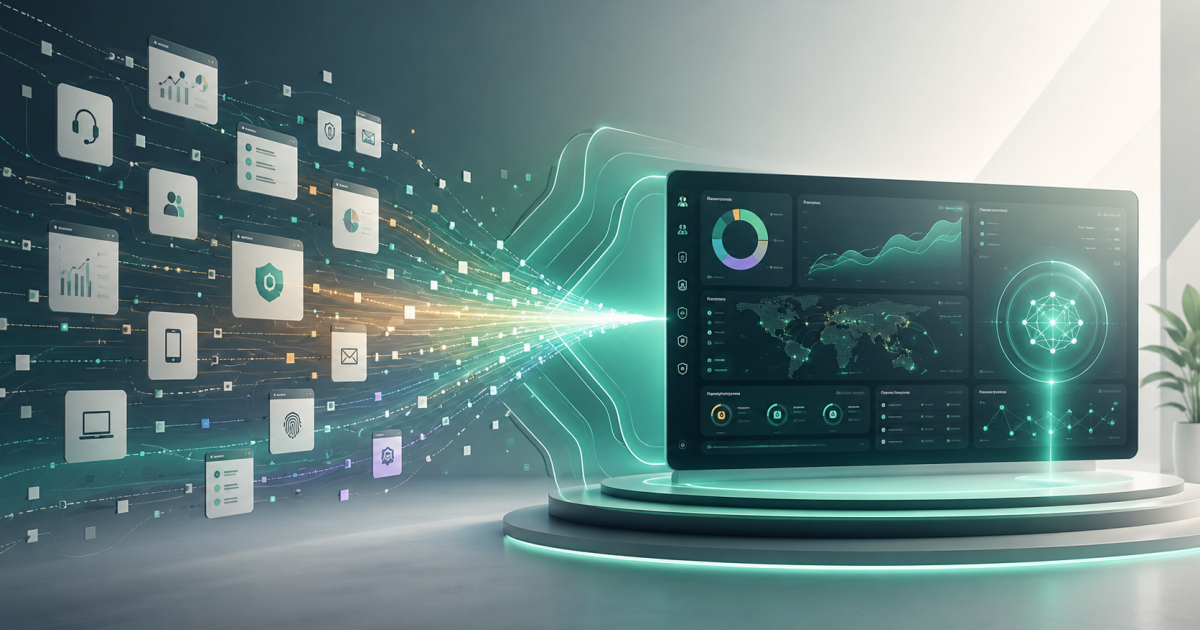
On the surface, it’s a pretty straightforward deal, with SuperOps bundling its unified PSA, RMM, MDM, ticketing, and automation platform with Guardz’s agentic security operations offering. Guardz combines identity, endpoint, email, and related security visibility, backed by 24/7 human-led MDR. The goal is to give MSPs a more connected foundation for operations, security, and AI readiness.
But, in the context of tool sprawl and fatigue, the partnership is deeper than just a services bundle. It’s really an acknowledgment that the old MSP model — treating IT operations and security as separate layers — doesn’t work.
Of course, the shift is being driven, at least partly, by AI. I’ve written a few times recently that AI agents can only be as effective as the data and systems they can access. If ticketing history lives in one tool, endpoint telemetry in another, and security alerts in a third, they AI agents may not be able to offer accurate recommendations, let alone perform remediation actions autonomously. That may be enough for limited automation, but it is not enough for the kind of agentic service delivery many vendors are now promising and which will truly benefit MSPs.
So, the question then becomes one of not only neat integration, but whether MSPs can create a viable data foundation across operations and security to provide AI with the context it needs to be truly useful.
The other change that’s happening —and this is directly related to the SuperOps/Guardz partnership — is the line between IT and cybersecurity is becoming increasingly blurred, especially with the introduction of more and more AI elements. An MSP cannot credibly position itself as enabling AI adoption if it does not also have visibility into identities, access, endpoint exposure, and risk. In other words, AI readiness and security readiness are tightly connected.
That’s the deeper message from Guardz and SuperOps — that security is no longer just another product line or add-on service, but is part of the service delivery foundation. With SuperOps as the operational system of record for MSPs, and Guardz adding a connected agentic security layer, the two are coming closer to a unified operating foundation rather than separate point tools.
Whether that really works remains to be seen. We’ve seen consolidation through integration promised in the past. It’s not about the messaging, but whether the experience is actually connected for the MSP and whether is meaningfully improves service delivery (and margins/profitability).
Still, the concept is hard to argue. MSPs are being asked to do two jobs that used to feel at least partially separate. They must keep client systems running and help them manage risk in an environment that is becoming more complex and more AI-driven. Doing both with a loosely stitched together stack has proven a challenge, at best. A foundational platform where operational and security data work together makes sense.
We’ll see how this plays out in reality and how other vendors respond, but it feels like SuperOps and Guardz are heading in a direction the market needs to go. AI needs complete data to be fully functional, so IT operations and security can’t exist in silos; they need to be unified in a holistic data platform.
The other question that has to be asked is how will this work in the longer term between the two companies? Can they maintain separate entities while providing the unified data platform they’re promising? Or, is a merger or acquisition on the horizon? I wouldn’t bet against the latter.
Edited by
Erik Linask